

What Happens to Facial Skin After GLP-1 Weight Loss?

What Happens to Facial Skin After GLP-1 Weight Loss?

GLP-1 medications have changed the conversation around weight loss. For many people, the results can be significant and incredibly positive. As the weight comes off, though, a new concern may show up in the mirror: “Why does my face suddenly look older?” “Why does my jawline look looser?” “Why does my skin look thinner or more crepey?” Many people also wonder whether the answer is filler.

Not necessarily. At Vasu Skin Solutions in Boulder, Colorado, the first step in treating facial changes after GLP-1 weight loss is understanding what actually changed. Weight loss can affect facial volume, skin laxity, texture, and overall skin quality, and each of these concerns may need a different approach.

What Does GLP-1 Weight Loss Do to Your Face?

You have probably heard the term “Ozempic face.” We are not particularly fond of it because facial changes after weight loss are not exclusive to Ozempic® or any one medication. Similar changes can happen after any significant or rapid weight loss.

When we lose weight, we cannot choose exactly where it comes from. The face loses fat, too, and facial fat provides important structural support. As that support decreases, you may begin to notice:

  • Hollowing through the cheeks or temples
  • More prominent lines and folds
  • Increased laxity along the jawline
  • Crepey or thinner-looking skin
  • Changes through the lower face and neck
  • An overall loss of firmness and skin quality

This is why treating the face after significant weight loss is rarely as simple as putting volume back. A thoughtful consultation helps determine whether the primary issue is volume loss, loose skin, texture, or a combination of these changes.

Why Does Skin Become Loose After GLP-1 Weight Loss?

Think of your skin as the outer envelope of your face. When facial volume decreases quickly, that envelope does not always contract at the same rate. The result can be skin laxity, particularly through the lower face, jawline, and neck.

Age plays a role, too. Younger skin generally has greater elasticity and may adapt more readily to changes in facial volume. As collagen and elastin naturally decline with age, skin may have a harder time adapting after substantial weight loss. This is one reason two people can lose the same amount of weight and see very different changes in their faces.

Collagen and Skin Quality After Weight Loss

Healthy-looking skin is not just about volume. It is also about the quality and structure of the skin itself. Collagen provides structure and firmness, while elastin helps the skin stretch and recoil. Both naturally change with age.

After significant weight loss, it is important to look beyond volume alone. If the skin is loose, crepey, or lacking firmness, improving collagen and skin quality may be more helpful than immediately adding filler. For some patients, restoring volume will be part of the plan; for others, skin tightening and collagen remodeling may be the better place to begin.

Does Everyone Need Filler After GLP-1 Weight Loss?

No. If you have lost significant structural volume, strategically placed dermal filler or a collagen-stimulating injectable may eventually be appropriate. However, filler does not solve every problem.

If the main concern is loose skin, loss of firmness, crepey texture, or declining skin quality, simply adding volume may not address what is actually bothering you. Too much volume can also create a result that does not look natural. The best approach is often to improve the skin, stimulate collagen, address laxity, and restore volume only where it is truly needed.

How Vasu Treats Loose Skin After GLP-1 Weight Loss

There is no single “GLP-1 face treatment.” At Vasu Skin Solutions in Boulder, we evaluate the different components of facial aging and post-weight-loss change individually, including skin laxity, collagen, texture, hydration, pigmentation, and structural volume. Then we build the treatment plan around your skin rather than trying to fit every patient into the same procedure.

Our goal is to determine what your skin needs and what will realistically make a difference.

HERE IS YOUR SKIN TIGHTENING + COLLAGEN REMODELING TEAM
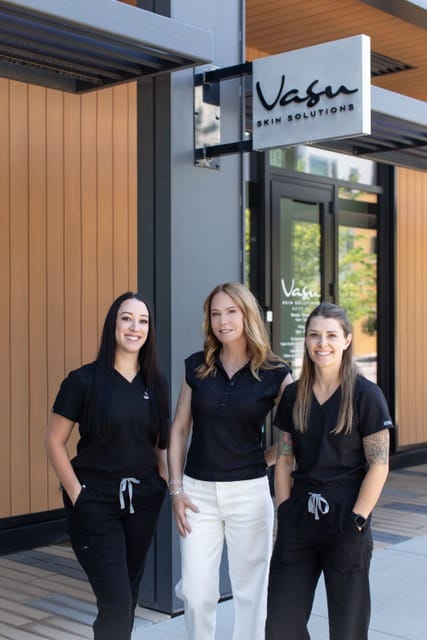
Lindsay, Jen, and Eirika, RN
Our goal is to determine what your skin needs—and what will realistically make a difference.

Meet Quadessy™: Radiofrequency Skin Tightening at Vasu

Quadessy™ is our newest technology for skin tightening and collagen remodeling. It is an advanced radiofrequency platform that delivers synchronized RF energy through three skin layers in a single pass: the epidermis, papillary dermis, and reticular dermis. The treatment is designed to support multi-layer collagen remodeling while addressing firmness, texture, and overall skin quality.

For patients who are noticing laxity or crepey skin after weight loss, the objective is straightforward: firmer skin, better texture, and improved skin quality. The goal is not to change your face shape. It is to help your skin look smoother, healthier, and more supported.

Quadessy™ + Tetra CO₂ CoolPeel®: Treating Different Levels of the Skin

Collagen remodeling and tightening are only part of the equation. After significant weight loss, you may also notice fine lines, uneven texture, sun damage, dullness, or changes in pigmentation.

That is why we may combine Quadessy with our Tetra CO₂ CoolPeel® laser. We use each technology for a different purpose: Quadessy for deeper collagen remodeling and tightening, and Tetra CoolPeel for surface renewal, texture, and tone. During your consultation, we can determine whether one treatment or a combination is appropriate for your skin.

Hydration and Overall Skin Quality

Great skin is not just about tightening. Hydration, texture, luminosity, and consistent skincare matter, especially when facial changes become more noticeable after significant weight loss. Medical-grade skincare may be recommended as part of your plan to support skin health before, during, and after in-office treatments.

VISIA® Skin Analysis: Measuring Your Results

At Vasu, we do not want to simply tell you that your skin looks better. We want to show you. VISIA® Skin Analysis helps establish a baseline and objectively document your skin before treatment. We combine that information with standardized photography and a clinical assessment to track changes throughout your treatment plan.

Seeing and tracking progress can help you understand how your skin is responding over time and guide any adjustments to your plan.

What Is the Best Treatment for Your Face After GLP-1 Weight Loss?

There is no universal answer because GLP-1 weight loss does not create one universal facial concern. Some patients need collagen remodeling and skin tightening with Quadessy. Some need CO₂ resurfacing with Tetra CoolPeel. Some need better hydration and overall skin quality. Some benefit from carefully placed injectable treatments, while others do not need treatment at all.

Our job at Vasu is not to sell you every treatment we offer. Our job is to determine what changed, what can realistically be improved, and what is worth treating. If we think a treatment will help, we will explain why. If we think something else would work better, we will tell you. If we do not think you need to spend the money, we will tell you that, too.

GLP-1 Skin Tightening in Boulder, Colorado

If you are experiencing facial volume loss, loose skin, crepey texture, or changes along your jawline and neck after GLP-1 or significant weight loss, Vasu Skin Solutions in Boulder can help determine what has changed and develop an individualized treatment plan.

Depending on your skin’s needs, that plan may include Quadessy™ radiofrequency skin tightening and collagen remodeling, Tetra CO₂ CoolPeel® resurfacing, VISIA® Skin Analysis, medical-grade skincare, and injectable treatments when appropriate. The goal is not to make you look like you did before you lost the weight. The goal is healthy, strong, beautiful skin that still looks like you.


What Happens to Facial Skin After GLP-1 Weight Loss?

GLP-1 medications have changed the conversation around weight loss. For many people, the results can be significant and incredibly positive. As the weight comes off, though, a new concern may show up in the mirror: “Why does my face suddenly look older?” “Why does my jawline look looser?” “Why does my skin look thinner or more crepey?” Many people also wonder whether the answer is filler.

Not necessarily. At Vasu Skin Solutions in Boulder, Colorado, the first step in treating facial changes after GLP-1 weight loss is understanding what actually changed. Weight loss can affect facial volume, skin laxity, texture, and overall skin quality, and each of these concerns may need a different approach.

What Does GLP-1 Weight Loss Do to Your Face?

You have probably heard the term “Ozempic face.” We are not particularly fond of it because facial changes after weight loss are not exclusive to Ozempic® or any one medication. Similar changes can happen after any significant or rapid weight loss.

When we lose weight, we cannot choose exactly where it comes from. The face loses fat, too, and facial fat provides important structural support. As that support decreases, you may begin to notice:

  • Hollowing through the cheeks or temples
  • More prominent lines and folds
  • Increased laxity along the jawline
  • Crepey or thinner-looking skin
  • Changes through the lower face and neck
  • An overall loss of firmness and skin quality

This is why treating the face after significant weight loss is rarely as simple as putting volume back. A thoughtful consultation helps determine whether the primary issue is volume loss, loose skin, texture, or a combination of these changes.

Why Does Skin Become Loose After GLP-1 Weight Loss?

Think of your skin as the outer envelope of your face. When facial volume decreases quickly, that envelope does not always contract at the same rate. The result can be skin laxity, particularly through the lower face, jawline, and neck.

Age plays a role, too. Younger skin generally has greater elasticity and may adapt more readily to changes in facial volume. As collagen and elastin naturally decline with age, skin may have a harder time adapting after substantial weight loss. This is one reason two people can lose the same amount of weight and see very different changes in their faces.

Collagen and Skin Quality After Weight Loss

Healthy-looking skin is not just about volume. It is also about the quality and structure of the skin itself. Collagen provides structure and firmness, while elastin helps the skin stretch and recoil. Both naturally change with age.

After significant weight loss, it is important to look beyond volume alone. If the skin is loose, crepey, or lacking firmness, improving collagen and skin quality may be more helpful than immediately adding filler. For some patients, restoring volume will be part of the plan; for others, skin tightening and collagen remodeling may be the better place to begin.

Does Everyone Need Filler After GLP-1 Weight Loss?

No. If you have lost significant structural volume, strategically placed dermal filler or a collagen-stimulating injectable may eventually be appropriate. However, filler does not solve every problem.

If the main concern is loose skin, loss of firmness, crepey texture, or declining skin quality, simply adding volume may not address what is actually bothering you. Too much volume can also create a result that does not look natural. The best approach is often to improve the skin, stimulate collagen, address laxity, and restore volume only where it is truly needed.

How Vasu Treats Loose Skin After GLP-1 Weight Loss

There is no single “GLP-1 face treatment.” At Vasu Skin Solutions in Boulder, we evaluate the different components of facial aging and post-weight-loss change individually, including skin laxity, collagen, texture, hydration, pigmentation, and structural volume. Then we build the treatment plan around your skin rather than trying to fit every patient into the same procedure.

Our goal is to determine what your skin needs and what will realistically make a difference.

HERE IS YOUR SKIN TIGHTENING + COLLAGEN REMODELING TEAM

Lindsay, Jen, and Eirika, RN
Our goal is to determine what your skin needs—and what will realistically make a difference.

Meet Quadessy™: Radiofrequency Skin Tightening at Vasu

Quadessy™ is our newest technology for skin tightening and collagen remodeling. It is an advanced radiofrequency platform that delivers synchronized RF energy through three skin layers in a single pass: the epidermis, papillary dermis, and reticular dermis. The treatment is designed to support multi-layer collagen remodeling while addressing firmness, texture, and overall skin quality.

For patients who are noticing laxity or crepey skin after weight loss, the objective is straightforward: firmer skin, better texture, and improved skin quality. The goal is not to change your face shape. It is to help your skin look smoother, healthier, and more supported.

Quadessy™ + Tetra CO₂ CoolPeel®: Treating Different Levels of the Skin

Collagen remodeling and tightening are only part of the equation. After significant weight loss, you may also notice fine lines, uneven texture, sun damage, dullness, or changes in pigmentation.

That is why we may combine Quadessy with our Tetra CO₂ CoolPeel® laser. We use each technology for a different purpose: Quadessy for deeper collagen remodeling and tightening, and Tetra CoolPeel for surface renewal, texture, and tone. During your consultation, we can determine whether one treatment or a combination is appropriate for your skin.

Hydration and Overall Skin Quality

Great skin is not just about tightening. Hydration, texture, luminosity, and consistent skincare matter, especially when facial changes become more noticeable after significant weight loss. Medical-grade skincare may be recommended as part of your plan to support skin health before, during, and after in-office treatments.

VISIA® Skin Analysis: Measuring Your Results

At Vasu, we do not want to simply tell you that your skin looks better. We want to show you. VISIA® Skin Analysis helps establish a baseline and objectively document your skin before treatment. We combine that information with standardized photography and a clinical assessment to track changes throughout your treatment plan.

Seeing and tracking progress can help you understand how your skin is responding over time and guide any adjustments to your plan.

What Is the Best Treatment for Your Face After GLP-1 Weight Loss?

There is no universal answer because GLP-1 weight loss does not create one universal facial concern. Some patients need collagen remodeling and skin tightening with Quadessy. Some need CO₂ resurfacing with Tetra CoolPeel. Some need better hydration and overall skin quality. Some benefit from carefully placed injectable treatments, while others do not need treatment at all.

Our job at Vasu is not to sell you every treatment we offer. Our job is to determine what changed, what can realistically be improved, and what is worth treating. If we think a treatment will help, we will explain why. If we think something else would work better, we will tell you. If we do not think you need to spend the money, we will tell you that, too.

GLP-1 Skin Tightening in Boulder, Colorado

If you are experiencing facial volume loss, loose skin, crepey texture, or changes along your jawline and neck after GLP-1 or significant weight loss, Vasu Skin Solutions in Boulder can help determine what has changed and develop an individualized treatment plan.

Depending on your skin’s needs, that plan may include Quadessy™ radiofrequency skin tightening and collagen remodeling, Tetra CO₂ CoolPeel® resurfacing, VISIA® Skin Analysis, medical-grade skincare, and injectable treatments when appropriate. The goal is not to make you look like you did before you lost the weight. The goal is healthy, strong, beautiful skin that still looks like you.

More Posts

Check Out Our Monthly Skincare Specials